

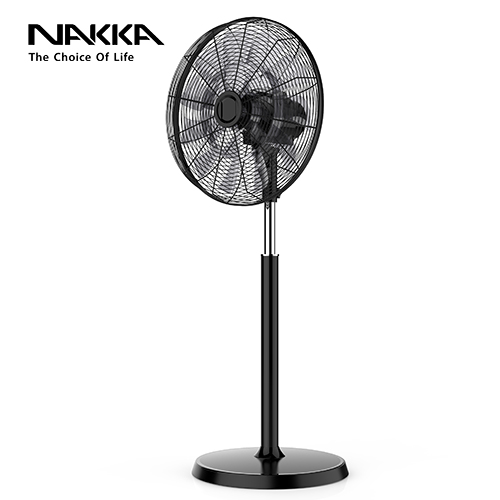
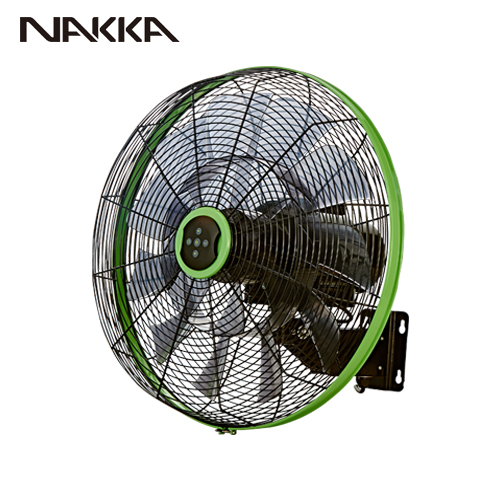
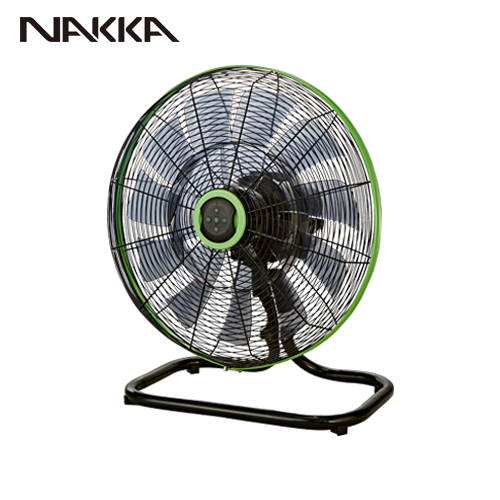
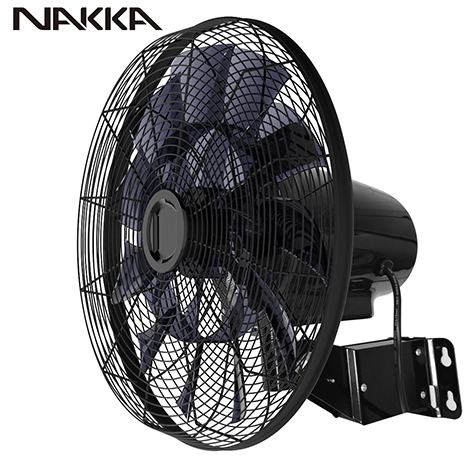
Firstly, it is necessary to clarify the differences between AC, BLDC, and EC fans:
AC fan: AC asynchronous (induction) motor, directly connected to the power grid, with speed locked by pole pairs and grid frequency. The common methods for cooling industrial cabinets are shielded pole motors (with an efficiency of only 30-50%) or capacitor operated PSC motors (60-75%).
BLDC fan: a DC brushless motor with permanent magnet rotor and electronic commutation, requiring low-voltage DC power supply (12/24/48V), with a motor efficiency of 85-95%.
EC fan: BLDC motor+built-in AC/DC conversion and drive control, can be directly connected to 90-270V AC mains power. The "EC fan replacement" mentioned in industrial retrofit is essentially the mains version of BLDC technology.
A common misconception to correct is that AC induction motors do not have carbon brushes (that is an old-fashioned brushed DC motor). The true losses of AC fans come from slip, excitation current, and winding copper loss, with the main failure points being bearing aging and starting capacitor bulging.
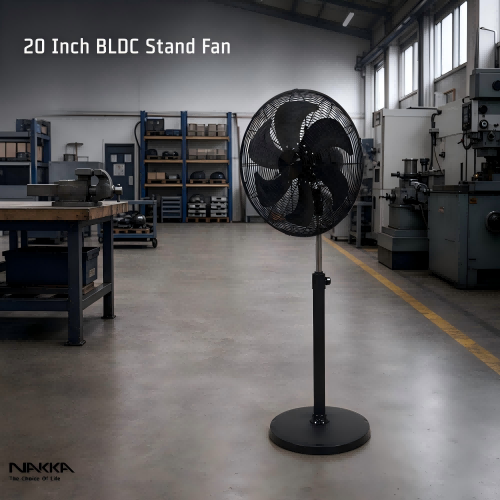
Four True Benefits in Industrial Scenarios
1. When deploying multiple machines, the electricity bill is very substantial
According to the 750mm model AC 320W vs NAKKA 30 INCH BLDC INDUSTRIAL FAN 125W、 Difference of 195W calculation:
Operating mode | Annual power saving per unit | Annual electricity cost per unit (0.12 usd/kWh) | 50 workshops |
12h/day × 300day | 702 kWh | About 84.3usd | About 4215usd/year |
24h × 330day | 1544.4 kWh | About 185.32usd | About9266 usd/year |
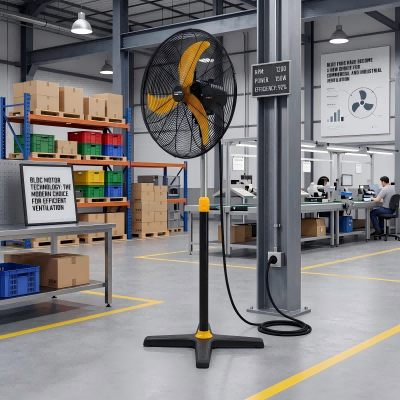
2. Low gear is the true power-saving zone, and most of the time the workshop does not require full speed
The fan power and speed are in a cubic relationship. BLDC can achieve extremely low speeds that AC fans cannot achieve, with power consumption as low as 3.5W in the first gear (measured in the sleep mode of the NAKKA 18 inch floor fan, with a fan speed of 200RPM), and only 0.09 degrees for 8 consecutive hours. AC fans rely on capacitors/reactors to reduce voltage and adjust gears. When in low gear, the torque is insufficient and the efficiency collapses. Some brands of AC fans experience a "reverse increase in actual power consumption" in low gear, which is the reason for this.
Night shift, shift change, transition season - the energy savings during these periods are more significant than during the day when the shift is full.
3. The noise level has decreased from 'hindering communication' to 'being able to speak normally'
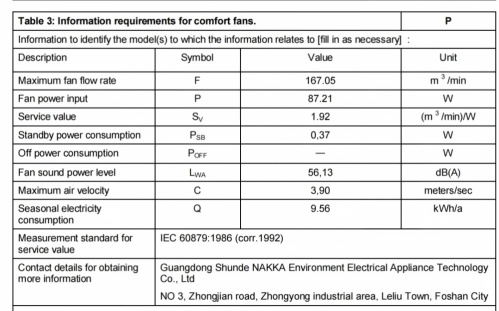
The difference in magnitude is from 60-70 dB (A) to 45-55 dB (A). For workstations that require language communication, intercom, and listening to abnormal machine sounds, it is a real safety and efficiency benefit. In addition, the inherent 50Hz frequency "buzzing" low-frequency sound of AC fans is more annoying than wind noise in enclosed workshops, and BLDC does not have this problem. NAKKA 18 inch pedestal fan is at the highest level, with a noise level of only 56dB.
4. Wall mounted installation is more user-friendly
BLDC motors have small size and light weight under the same torque, and the support load and installation difficulty of wall mounted fans are reduced. The fatigue risk of walls/columns that are hung at high places for a long time is also smaller. Soft start also means that when dozens of AC motors are powered on simultaneously, there is no starting shock of 3-5 times the rated current of the AC motor.
Confirm item by item during procurement:
1. Choose according to the air volume (m ³/h) instead of size. If necessary, choose one size larger
For example, NAKKA 30 Inch BLDC industrial fan air volume is 280m³/min.
2. Protection level ≥ IP54, fully sealed machine head, confirmed no external adapter.
For example, NAKKA has the IP54 waterproor and dustproof rate fan, and could be connected with 220V or 110V AC power.
3. Confirm the wide voltage operating range (such as 160-260V) and built-in surge protection.
NAKKA also have the 160~240V wide voltage used fan, for some voltage not stable area to use.
4. Separate the motor warranty and controller (PCB) warranty, and the warranty period of the PCB is crucial.
For example, NAKKA could provide 2 years warranty for the fan PCB fan part.
5. There must be physical buttons on the body, not purely remote control.
NAKKA supports two ways to operate the fan in normal, one is the control panel on the fan motor. Another one is by RF remote control. If need a upgrade used, the fan could add wifi module then the fan could operate by phone.
6. Confirm the upper limit of the controller's operating temperature and leave a margin in the high-temperature workshop.
For example, NAKKA fan all pass temperature rise testing, there is no problem using it for a long time in an environment of 40 degrees Celsius.
7. Ask if there are authorized service points and spare parts inventory cycles locally
8. Calculate TCO: AC purchase price+3-year electricity bill+capacitor/bearing replacement, compare with BLDC purchase price+3-year electricity bill+one possible board replacement
